
How Quantity Offers Increase Your COD Revenue Without Increasing Your Ad Spend
Most COD merchants think about growth in terms of traffic: more ads, more visitors, more orders. This is an expensive way to grow.
There is a cheaper, faster lever that most COD merchants underuse: getting each customer who is already buying to spend more per order.
Quantity offers — discounts or incentives tied to buying more than one unit of the same product — are one of the most effective tools available for increasing average order value (AOV) in COD ecommerce. When implemented correctly, directly inside the order form at the moment of purchase, they require no additional traffic, no additional ad spend, and no change to your logistics setup.
This article explains the mechanics, the psychology, and the implementation of quantity offers in a COD context — and why the order form is the right place to deploy them.
The Math Behind AOV Optimization
Before getting into tactics, it is worth understanding why average order value matters so much to a COD merchant specifically.
Every order you ship has a fixed cost component that does not scale with order value: packaging, the courier fee, your confirmation call, and the operational overhead of processing the order. For a COD merchant shipping at $5 per order, an order worth $15 and an order worth $45 have the same logistics cost — but one generates three times the gross revenue.
This means that increasing AOV has an outsized effect on profitability compared to increasing order volume. If you double your order volume, you double your logistics costs. If you double your AOV while keeping volume constant, your logistics costs stay the same and your gross margin per order increases dramatically.
Consider two scenarios for a merchant doing 300 orders per month:
Scenario A: 300 orders at $20 AOV = $6,000 revenue. Shipping cost: $1,500. Gross after shipping: $4,500.
Scenario B: 300 orders at $35 AOV (achieved through quantity offers) = $10,500 revenue. Shipping cost: $1,500. Gross after shipping: $9,000.
Same number of orders. Same ad spend. Same logistics complexity. But $4,500 more in gross revenue retained — simply because each customer bought more.
This is the core argument for quantity offers in COD ecommerce.
The Psychology of Quantity Discounts
Quantity offers work because they tap into several well-documented psychological principles simultaneously.
Perceived value. When a customer sees "Buy 2, get 15% off," they immediately perceive the bundle as a better deal than the single unit — even if they were not initially planning to buy two. The discount reframes the decision from "do I want this product?" to "do I want this product at a better price?" This is a fundamentally easier question to say yes to.
Loss aversion. The most effective framing for quantity offers is not "save 15%" — it is "don't miss this offer." People are more motivated by avoiding a loss than by gaining an equivalent benefit. Showing the price difference between buying one versus two units, with the single-unit option framed as the more expensive choice, leverages this bias effectively.
Reduced decision friction. For customers who were already going to buy the product, a quantity offer with a visible discount removes the need to decide whether to come back for a second order later. The decision is made once, in the moment, when purchase intent is at its peak.
Social proof through volume. "Our most popular choice" applied to a 2-unit or 3-unit option signals that other buyers made the same choice — reducing the perceived risk of buying more.
What the Data Shows
The impact of product bundling and quantity offers on average order value is well-documented.
Research consistently shows that product bundles and quantity discounts increase AOV by 20 to 30% on average, with some implementations achieving 55% AOV lifts when executed with clear value communication. For COD merchants where the average order value often sits in the $15 to $40 range, even a 20% AOV increase translates directly into meaningful margin improvement given the fixed cost structure described above.
The psychological principle of BOGO (buy one get one) and quantity discounts is particularly powerful: 66% of shoppers rank these types of offers as their favorite deal format. For impulse-purchase COD buyers — which describes a significant portion of COD customers in MENA and Africa — this preference is even more pronounced.
Critically, quantity offers at checkout convert at higher rates than the same offers presented on product pages. This is because checkout is the moment of highest purchase intent. The customer has already decided to buy — the quantity offer simply asks whether they want a better deal while they are in that decision-making frame.
How to Structure Quantity Offers for COD
Not all quantity offer structures work equally well in a COD context. COD buyers have specific characteristics — they are often mobile-first, price-sensitive, and making decisions quickly — that shape which offer structures perform best.
The Two-Tier Structure (Most Effective)
Present two options: single unit at full price, and two units at a discount.
Example:
- 1 unit: $25
- 2 units: $42 (save $8 — 16% off)
This structure works because it presents a clear, simple choice. The customer does not need to calculate anything. The saving is visible and concrete. For a buyer who is already convinced enough to buy one unit, the incremental decision to buy two is low-effort.
The Three-Tier Structure (Best for Consumables)
Present three options with increasing discounts at each level.
Example:
- 1 unit: $25
- 2 units: $42 (save $8)
- 3 units: $60 (save $15 — 20% off)
The three-tier structure works particularly well for consumable or replenishable products — skincare, supplements, household products — where buying more makes objective sense because the customer will use more over time. It also leverages the "middle option" effect: when presented with three choices, most people choose the middle one, which in this case is still a multi-unit purchase.
The Conditional Discount Structure
Offer a discount that applies when the quantity reaches a threshold.
Example: "Buy 2 or more and get 10% off your entire order"
This structure works well when you want to maintain full-price perception on single-unit purchases while incentivizing multi-unit buying. It is slightly less effective than the explicit tiered pricing because it requires the customer to do a small mental calculation — but it has the advantage of being simple to communicate.
Where to Place the Quantity Offer: Inside the Order Form
This is the critical implementation decision, and it is where most merchants get it wrong.
The standard approach is to display quantity options on the product page, before the customer reaches checkout. This is better than nothing, but it misses the highest-converting placement.
The right place for a quantity offer in a COD context is inside the order form itself, displayed after the customer has committed to placing an order — ideally as a visible option adjacent to the product summary.
Here is why this placement outperforms product page placement:
Intent is highest at checkout. A customer filling in their delivery address has made the decision to buy. They are in execution mode, not evaluation mode. An offer presented at this moment meets them at peak intent.
Comparison is easy. With the order summary visible on the same screen, the customer can see exactly what they are paying for a single unit and immediately compare it to the two-unit price. The decision is made with full information, which reduces buyer's remorse and return rates.
No additional navigation required. Presenting the quantity offer inside the form means the customer does not need to go back to the product page, change the quantity, and return to checkout. One tap upgrades the order. Frictionless upsell = higher conversion.
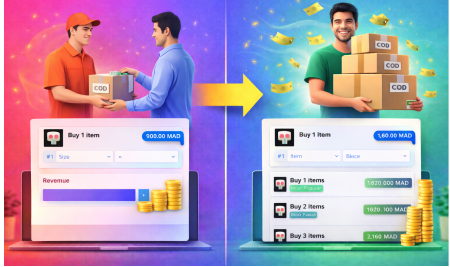
LeadForm's quantity offer feature displays tiered pricing options directly inside the COD order form. Customers see the single-unit price and the multi-unit discount simultaneously, and can upgrade their order with a single selection — without leaving the form or restarting the checkout process.
What Products Work Best With Quantity Offers
Quantity offers do not work equally well for all products. Before implementing, evaluate your product against these criteria:
High-repeat-use products. Skincare, cleaning products, supplements, and consumables all benefit from quantity offers because the customer will genuinely use multiple units. Buying three bottles of face wash is not wasteful — it is practical. This makes the decision to upgrade easier.
Low-perishability products. If the product has a long shelf life or does not expire, customers are comfortable buying multiple units without worrying about waste.
Products with a natural "gift" use case. Many COD markets have strong gift-giving cultures. A product that can plausibly be purchased as a gift — clothing, accessories, personal care items — can be framed as "buy one for yourself, one as a gift" which dramatically increases the perceived value of the two-unit option.
Products where variety adds value. If you offer the same product in multiple colors or scents, a multi-unit offer can be framed as a variety pack — "try all three scents" — which is a different and often more compelling angle than a pure price discount.
Practical Implementation: Getting It Right
A few implementation details determine whether your quantity offer increases revenue or creates confusion:
Show the math explicitly. Do not make customers calculate the savings. Display the single-unit price, the multi-unit price, and the saving amount (both in currency and percentage) simultaneously. "Buy 2 for $42 — save $8" is more effective than "Buy 2 for $42."
Default to the single-unit option. Pre-selecting the multi-unit option as default feels manipulative and erodes trust. Let the customer choose. The offer should feel like an opportunity, not a pressure tactic.
Keep it simple. Two or three options maximum. More options create decision paralysis, which leads to abandonment rather than upgrade.
Test your price points. The right discount depth depends on your margins and your audience's price sensitivity. Start with 10 to 15% for a two-unit option and test whether higher discounts meaningfully improve conversion rates. In many cases, the visibility of a deal matters more than the size of the discount.
The Revenue Impact Over Time
Quantity offers, once implemented, generate compounding returns. Every order that upgrades from one unit to two is permanent margin improvement — it happens automatically, without any ongoing effort on your part.
If 20% of your 300 monthly orders upgrade from a $20 single-unit order to a $35 two-unit order, that is 60 orders with an additional $15 each — $900 in additional monthly revenue from the same traffic, the same ad spend, and the same operational setup.
Over a year, that is $10,800 in additional revenue. From a feature you set up once.
This is the compounding logic of AOV optimization: it is not a one-time gain. Every month, it works silently on your behalf, improving the economics of every order that goes through your store.