
How to Recover Abandoned COD Orders on Shopify (And Turn Lost Sales Into Revenue)
Most Shopify merchants obsess over getting traffic to their store. Very few pay attention to what happens to the customers who almost bought — the ones who filled in their phone number, started the COD order form, and then disappeared.
This is one of the most expensive blind spots in COD ecommerce.
A customer who has typed their phone number into your order form is not a cold lead. They found your product, they were interested enough to start the checkout process, and they gave you their contact information. They are, by every measure, a warm buyer. Something stopped them at the last moment — hesitation, distraction, a question they couldn't answer, or simply getting interrupted by life.
The merchants who recover these orders systematically outperform those who treat every abandoned form as a lost cause. This article shows you exactly how to do it.
The Scale of the Problem
Cart and order abandonment is not a niche problem. It is the defining conversion challenge of ecommerce.
Globally, the average cart abandonment rate sits at approximately 75%. That means three out of every four people who start a purchase do not complete it. On mobile — where the overwhelming majority of COD buyers in MENA and Africa are shopping — abandonment rates climb even higher, reaching nearly 80%.
For COD merchants specifically, the problem is compounded by the nature of the checkout experience. A customer who is uncertain about a COD purchase has zero financial commitment stopping them from abandoning. Unlike a prepaid buyer who has already entered card details and is psychologically committed to completing the transaction, a COD buyer can walk away at any point with no cost. This makes the abandonment trigger lower — but it also means that a well-timed follow-up message can bring them back, because there is no payment friction to overcome.
The financial stakes are significant. If your store processes 200 COD orders per month with an average order value of $30, and your abandonment rate is 70%, that means approximately 467 people started an order but did not complete it. Even recovering 15% of those — the low end of what automated recovery achieves — is 70 additional orders, or $2,100 in revenue that would otherwise be permanently lost.
That is not found money. It is money that was already in your funnel, attached to a real person who wanted your product.
Why COD Order Abandonment Is Different From Regular Cart Abandonment
Standard ecommerce cart abandonment recovery relies heavily on email. Send a reminder, offer a discount code, link back to the cart. It works reasonably well for prepaid buyers in Western markets.
For COD buyers in MENA and Africa, this approach fails for two structural reasons.
Email is the wrong channel. COD buyers in these markets do not have the same email culture as Western shoppers. Many do not regularly check email, especially for commercial messages. An abandoned cart email sent to a COD buyer in Morocco or Egypt has a fraction of the impact it would have in a European market.
WhatsApp is where they actually are. In MENA and Africa, WhatsApp is not just a messaging app — it is the primary communication channel for everything from personal conversations to business interactions. Open rates for WhatsApp messages are consistently above 90%, compared to 20-30% for email. Response rates are dramatically higher. And critically, it is the channel your customers already use to communicate with businesses they trust.
This is why WhatsApp-based abandoned order recovery is not just an alternative to email recovery — for COD merchants in these markets, it is the only recovery channel that meaningfully works.
How the Recovery Flow Works
The mechanics of COD order abandonment recovery are straightforward once you understand the trigger point.
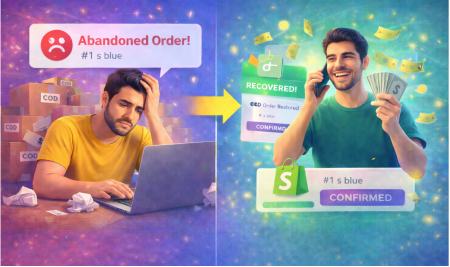
When a customer fills in their phone number on your COD order form but does not complete the order, that phone number is captured — even without a submitted order. This is the abandonment event. The customer's phone number is known, their intent has been demonstrated, and the clock starts.
The 15-minute window is critical.
Recovery data consistently shows that the faster the follow-up, the higher the recovery rate. A message sent within 15 minutes of abandonment reaches the customer while they are still in a purchasing mindset — potentially still on their phone, still thinking about the product. A message sent 6 hours later reaches them in a completely different mental state.
LeadForm's abandoned order recovery feature triggers automatically when a phone number is captured but no order is completed. After 15 minutes, a WhatsApp message is sent to the customer directly.
The Recovery Message: What Works and What Doesn't
The message itself matters enormously. A poorly written recovery message will be ignored or, worse, create a negative impression of your brand. A well-written one brings the customer back.
What doesn't work:
Generic messages — "You left something in your cart!" — feel impersonal and are easily dismissed. Aggressive discount offers sent immediately signal desperation and may train your customers to abandon intentionally to get a discount. Long messages that require reading effort get ignored.
What works:
Short, personal, and specific. The message should reference the product they were looking at, feel like it comes from a real person rather than an automated system, and give the customer a clear, low-friction path back to completing their order.
Here are three proven message frameworks:
Framework 1 — Simple reminder (no discount):
"Hi [Name], we noticed you were checking out [Product Name]. Your order is saved and ready whenever you are. Complete it here: [Link]"
This works for customers who abandoned due to distraction rather than hesitation. It is non-pushy, personal, and makes completion effortless.
Framework 2 — Hesitation handler (with soft incentive):
"Hi [Name], still thinking about [Product Name]? We completely understand. To make it easier, here's 10% off your order — valid for the next 24 hours: [Link + Discount Code]"
This works for customers who were on the fence. The time limit creates urgency without being aggressive, and the discount removes the last financial barrier.
Framework 3 — Objection addresser:
"Hi [Name], we saw you were looking at [Product Name]. If you had any questions — about the product, delivery, or anything else — just reply here and we'll answer immediately. Your order is ready when you are: [Link]"
This works for customers who abandoned because they had an unanswered question. It opens a conversation rather than pushing for an immediate transaction, which builds trust with hesitant first-time buyers.
The Optional Discount: When to Use It and When Not To
Using a discount in your recovery message is a lever — and like all levers, it has trade-offs.
Arguments for offering a discount:
A discount directly addresses price-based hesitation, which is one of the most common abandonment reasons. For first-time buyers who do not yet trust your brand, a small financial incentive can tip the decision. The incremental margin from a recovered order — even at a 10% discount — is almost always positive, since the alternative is zero revenue.
Arguments against automatic discounting:
If customers learn that abandoning an order reliably produces a discount, some will start abandoning intentionally. This erodes your margins without improving your actual conversion rate. It also devalues your product.
The recommended approach:
Use a two-step recovery sequence. The first message (sent at 15 minutes) is a simple reminder with no discount. The second message (sent at 2–4 hours if there is no response to the first) can include a discount offer for customers who have not responded to the neutral reminder.
This approach preserves margins for customers who would have converted without an incentive, while still capturing customers who needed the extra push.
Measuring Your Recovery Performance
Once you have an abandonment recovery system in place, track these metrics:
Abandonment rate. What percentage of customers who start your COD form do not complete an order? This is your baseline. For a well-optimized form, the abandonment rate should be below 60%. Higher than that suggests a form UX problem in addition to a recovery problem.
Recovery rate. What percentage of abandoned orders are successfully recovered through your WhatsApp follow-up? Industry benchmarks for WhatsApp recovery in COD markets suggest a recovery rate between 10% and 25%, depending on message quality, timing, and product category.
Revenue recovered. The direct financial impact of your recovery system, calculated as recovered orders × average order value. This is the number that justifies the investment.
Discount usage rate. What percentage of recovered orders required a discount to convert? If this number is very high, your initial messaging or product pricing may need adjustment.
The Compounding Effect
The most important thing to understand about abandoned order recovery is that it is not a one-time fix — it is a compounding revenue system.
Every month, a percentage of your traffic generates abandoned orders. Without a recovery system, that revenue is gone. With a recovery system in place, a portion of it comes back automatically, every month, with no additional ad spend.
At 200 monthly orders with a 70% abandonment rate and a 15% recovery rate, that is 70 recovered orders per month. At $30 AOV, that is $2,100 per month in recovered revenue — $25,200 per year — from a system you set up once and that runs automatically.
The merchants who build this infrastructure early gain a compounding advantage over those who do not. Every month of not having a recovery system is a month of permanently lost revenue.
Getting Started
The barrier to implementation is lower than most merchants expect. LeadForm's abandoned order recovery feature captures phone numbers at the point of form entry and triggers WhatsApp messages automatically after your defined window — no manual follow-up required.
Start with a single recovery message at 15 minutes. Measure your recovery rate for 30 days. Then optimize the message, test a two-step sequence, and decide whether to add an optional discount for non-responders.
The customers are already there. They already want your product. You just need a system to bring them back.